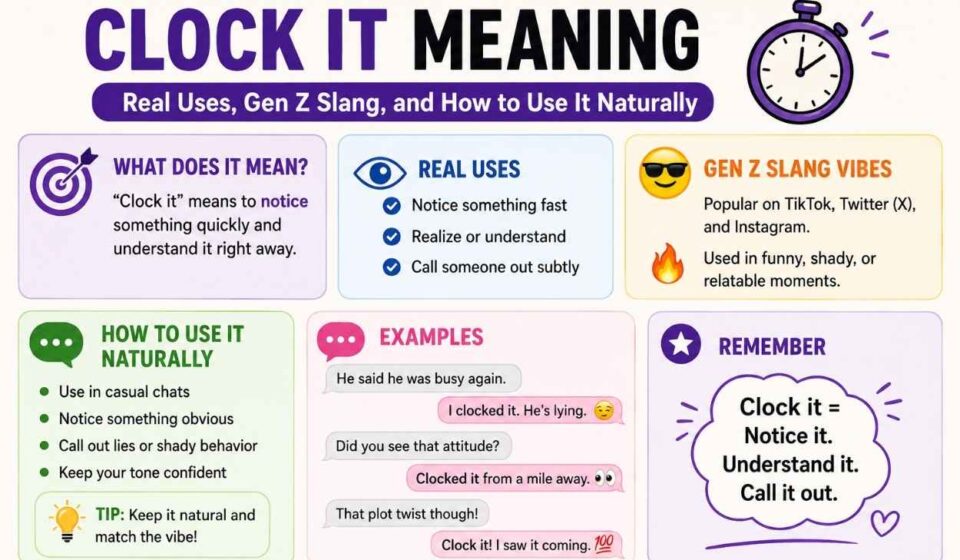

“Clock it” can sound like it has something to do with checking the time, but in modern slang, that usually isn’t what people mean. Online, clock it generally means to notice something, recognize what’s really happening, or point out a detail that someone else may have missed. Depending on the situation, it can also mean “exactly,” “you caught that,” or “call that out.”
The phrase has a deeper history in queer and ballroom culture, while its current viral use has spread widely through TikTok and other social platforms. Context matters, especially because “clocking” can carry a more specific meaning in LGBT communities.
Quick Answer
“Clock it” means to notice, recognize, figure out, or call attention to something—especially a detail, behavior, contradiction, or hidden truth.
For example:
“He says he doesn’t like her, but he watches all her stories.”
“Clock it.”
Here, clock it means something like “Exactly—you noticed what’s really going on.”
It can be complimentary, playful, sarcastic, or slightly shady depending on the situation. In online slang, you may also see “I clocked that,” “you clocked it,” “clock that,” or “clock it 🤏.”
Also read: BBBJ Meaning in Texting Use, Safety Context, and Clear Examples
What Does Clock It Mean
The phrase clock it has several closely related uses, but they all revolve around noticing or recognizing something.
The most common modern meaning is to catch a detail or understand what is really happening.
If your friend notices that someone is pretending to be uninterested while obviously flirting, your friend might say:
“I clocked that immediately.”
That means:
“I noticed what was happening right away.”
“Clock it” can also be used as a short response to someone else’s observation. In that case, it can mean “you got it,” “that’s exactly right,” “notice that,” or “you caught the important part.”
The tone depends heavily on context. Saying “clock it” after a clever observation can sound approving. Saying it about someone’s behavior can sound like you’re exposing them.
So, while clock it is often associated with Gen Z slang today, the basic idea is not simply “agree.” It is more specifically about recognition, observation, or calling attention to something.
Clock It Meaning in Slang
In slang, clock it usually means notice it, catch it, recognize it, or call it out.
The expression is especially useful when something is obvious to you but another person may have thought they were hiding it.
For example:
“She said she wasn’t mad, but she slammed the door.”
“Clock it.”
The response points out the contradiction: her actions revealed how she actually felt.
You might also hear:
- “I clocked that.” — I noticed that.
- “You clocked it.” — You correctly noticed or understood it.
- “Clock that.” — Pay attention to that point.
- “They got clocked.” — Their behavior or truth was noticed/exposed.
- “It’s not clocking.” — Someone isn’t understanding or noticing what seems obvious.
The phrase can be playful rather than aggressive. A friend could “clock” your obvious crush, a suspicious excuse, a contradiction in someone’s story, or a detail hidden in a viral video.
Clock It Meaning in Text
In texting, clock it is a quick way to react to an observation without writing a long response.
For example:
Person A: “He said he was too busy to reply, but he’s been posting all night.”
Person B: “Clock it.”
Person B is essentially saying, “Exactly. You noticed the contradiction.”
Another example:
Person A: “Wait, isn’t that the same jacket she wore in his photo?”
Person B: “I clocked it too.”
Here, the speaker means they noticed the same detail.
Because texting lacks facial expressions and body language, the tone can sometimes be ambiguous. A person writing “clock it” may be agreeing, joking, teasing, or making a sharp observation. Emojis, punctuation, and the surrounding conversation often reveal the intended tone.
What Does Clock It Mean on Social Media
On TikTok, Instagram, X, Reddit, and other social platforms, clock it often works as a compact reaction to something revealing or surprisingly accurate.
Someone might use it under a video when a creator notices a contradiction, identifies a red flag, points out an obvious relationship dynamic, or catches a tiny detail in a celebrity or pop-culture moment.
For example:
“Everyone ignored the fact that he changed his story three times.”
“CLOCK IT.”
The commenter isn’t talking about time. They’re emphasizing that the observation is accurate and worth noticing.
The phrase fits social media particularly well because short reactions can communicate an entire attitude. “Clock it” can mean “I see it,” “that’s the truth,” “you caught that,” or “everyone needs to pay attention to this.”
Its current online popularity has been reinforced by viral TikTok content, memes, reaction videos, and other internet conversations. However, it wasn’t invented by TikTok; the phrase has older cultural roots.
Clock It 🤏 Meaning and Hand Gesture
When you see “clock it 🤏,” the 🤏 emoji is usually being used as a visual approximation of the finger-tapping gesture associated with the phrase.
In current internet usage, the gesture commonly involves repeatedly tapping a finger against the thumb. Online versions sometimes use the index finger, while descriptions of the traditional ballroom finger clap identify the middle finger and thumb.
The gesture adds emphasis to the statement. Think of it as a physical punctuation mark.
For example:
“He said he doesn’t care, but he keeps bringing her up. Clock it 🤏”
The gesture reinforces the idea:
“Notice that detail. That’s the point.”
You don’t need to use the gesture every time you say “clock it.” In casual conversation, it can simply be a playful way of emphasizing a sharp observation.
It’s also worth knowing that the gesture has its own history and shouldn’t automatically be treated as something created by today’s TikTok trend. Its connection to ballroom culture is older than its recent mainstream internet popularity.
Clock It Meaning from a Girl
If a girl says “clock it,” “I clocked that,” or “you clocked it,” the basic meaning doesn’t change because of her gender.
She may be saying:
- “I noticed that.”
- “I figured that out.”
- “You’re right.”
- “You caught the detail.”
- “That’s exactly what happened.”
- “You’re calling out the truth.”
For example:
“You thought I wouldn’t notice you liking all his old pictures?”
“Girl, I clocked it.”
That sounds playful and teasing.
On the other hand:
“I clocked the way he changed his story.”
This could be a more serious observation.
Don’t automatically assume “clock it” from a girl has a romantic or flirtatious meaning. The surrounding conversation matters much more than the speaker’s gender.
Clock It Origin
The modern slang expression has roots in drag and ballroom culture, particularly Black and Latinx LGBTQ+ communities in New York. It is therefore misleading to describe “clock it” as a brand-new Gen Z phrase invented by TikTok.
In ballroom-related usage, clocking has historically involved noticing or identifying something that reveals what is beneath a person’s presentation. That meaning is more culturally specific than the generalized social-media version used today.
The exact history of the phrase and its different uses is complicated, and there isn’t a reliable basis for assigning one precise person or date as its single inventor.
The expression later spread beyond those communities through popular culture and social media. During the 2020s, TikTok and viral internet content helped make “clock it” familiar to a much wider audience. A viral 2025 moment involving Love Island USA contestant Ace Greene and the associated finger-tapping gesture helped further connect the phrase with mainstream online culture.
That wider popularity doesn’t erase its cultural history. In fact, understanding the origin helps explain why the phrase can have different levels of meaning depending on who is using it and in what context.
Clock It vs Call It Out
Clock it and call it out overlap, but they aren’t perfect synonyms.
Call it out usually emphasizes openly criticizing or confronting something.
Clock it emphasizes noticing, recognizing, or accurately identifying something. It can involve a callout, but it doesn’t have to.
For example:
“I clocked that he was lying.”
This means you recognized the lie.
“I called him out for lying.”
This means you directly confronted him about it.
Someone can clock something without saying anything. That’s an important difference.
| Expression | Main idea | Typical tone |
|---|---|---|
| Clock it | Notice or recognize something | Observant, playful, sometimes shady |
| Call it out | Directly point out or challenge something | More confrontational |
| Notice it | Become aware of something | Neutral |
| Catch it | Spot something | Casual |
| Expose it | Reveal something hidden | Stronger or more dramatic |
Clock It Meaning in LGBT Culture
“Clock it” has a more specific and historically significant place in LGBTQ+ and ballroom culture than its current mainstream internet use might suggest.
In ballroom contexts, clocking can refer to recognizing a detail about someone’s presentation that reveals something they may not have intended to make obvious. The term has particularly strong associations with trans and queer experiences, where being “clocked” can refer to someone identifying a person as transgender based on perceived clues in their appearance or presentation.
That meaning is different from simply saying “I noticed that” in a TikTok comment.
The phrase’s movement into mainstream internet culture has also raised questions about cultural borrowing. Some ballroom voices have criticized the way expressions from Black and Latinx queer and trans communities can become viral trends while their origins are forgotten.
So if you’re using the phrase casually, it’s useful to understand that clock it has a cultural history beyond its current Gen Z meaning.
Comparison Table
| Use | Meaning | Example | Tone |
|---|---|---|---|
| General slang | Notice or recognize something | “Clock it.” | Casual |
| Texting | Catch a detail or contradiction | “I clocked that.” | Conversational |
| Social media | Agree with or highlight an observation | “Clock it 🤏” | Playful/emphatic |
| Callout | Identify someone’s behavior | “She clocked his lie.” | Sharp |
| Ballroom/LGBT context | A more culturally specific form of recognition or identification | “He got clocked.” | Context-sensitive |
| Gesture | Emphasize recognition or approval | 🤏 | Expressive |
Common Idioms
Several common English expressions are related to the general idea behind clock it. They aren’t exact replacements in every situation, but they can help explain the concept.
Call a Spade a Spade
Call a spade a spade means to describe something plainly and honestly instead of avoiding the obvious truth.
Example:
“He’s not being mysterious. He’s ignoring you.”
That blunt honesty overlaps with the directness sometimes associated with “clock it.”
Hit the Nail on the Head
Hit the nail on the head means to describe something exactly or identify the correct point.
Example:
“You hit the nail on the head when you said the problem was communication.”
Like “you clocked it,” it can praise someone for getting an observation exactly right.
Read the Room
Read the room means to understand the mood, situation, or reactions of the people around you.
Example:
“Everyone is upset. Read the room.”
It focuses more on social awareness than spotting a specific hidden detail.
Get the Message
Get the message means to understand what someone is communicating, whether directly or indirectly.
Example:
“She stopped replying for a reason. Get the message.”
Pick Up On
Pick up on means to notice or recognize something, especially something subtle.
Example:
“Did you pick up on the tension between them?”
This is one of the closest everyday alternatives to “clock it.”
Catch On
Catch on means to understand something, especially after initially missing it.
Example:
“It took me a minute, but I finally caught on.”
See Through Someone
See through someone means to recognize that their behavior or appearance isn’t completely genuine.
Example:
“He tried to act confident, but she saw right through him.”
This can overlap with “clocking” someone’s behavior.
Put Two and Two Together
Put two and two together means to connect separate clues and reach a conclusion.
Example:
“Once I saw both pictures, I put two and two together.”
Spill the Tea
Spill the tea means to share gossip, drama, or interesting information.
Example:
“Okay, spill the tea. What happened?”
It’s related to online callout culture but doesn’t mean the same thing as “clock it.”
Tell It Like It Is
Tell it like it is means to speak honestly and directly.
Example:
“She always tells it like it is.”
Face the Music
Face the music means to accept the consequences of something you’ve done.
Example:
“You broke the rules, so now you have to face the music.”
Let the Cat Out of the Bag
Let the cat out of the bag means to accidentally or intentionally reveal a secret.
Example:
“He let the cat out of the bag about the surprise party.”
Cut to the Chase
Cut to the chase means to stop wasting time and get directly to the important point.
Example:
“Let’s cut to the chase. Are you coming or not?”
State the Obvious
State the Obvious means to say something that is already very clear.
Example:
“You’re stating the obvious.”
“Clock it” can sometimes be used after someone points out that obvious fact.
Beat Around the Bush
Beat around the bush means to avoid saying something directly.
Example:
“Stop beating around the bush and tell me what happened.”
Put Someone on the Spot
Put someone on the spot means to force someone to answer or respond, often unexpectedly.
Example:
“That question really put him on the spot.”
Blow the Whistle
Blow the whistle means to expose wrongdoing or report something improper.
Example:
“She blew the whistle on the company’s illegal practices.”
This is much more serious than casual slang like “clock it.”
Read Between the Lines
Read between the lines means to understand a hidden or indirect meaning.
Example:
“He said he was fine, but read between the lines.”
This is closely related to the observational side of “clock it.”
Keep It Real
Keep it real means to be honest, genuine, or realistic.
Example:
“Keep it real with me. Do you actually like the idea?”
Say It to My Face
Say It to My Face means to confront someone directly rather than talking about them behind their back.
Example:
“If you have a problem, say it to my face.”
Practical Usage
“Clock it” works best in casual, informal communication.
You can reasonably use it with friends, in group chats, social-media comments, memes, casual conversations, and other settings where slang is normal.
It can also work as a reaction:
“He really thought nobody noticed.”
“Clock it.”
Or as a statement:
“I clocked the change in her attitude.”
The phrase can have different emotional shades:
- Approval: “You noticed the important point.”
- Recognition: “I saw what happened.”
- Agreement: “That’s exactly right.”
- Teasing: “I caught you.”
- Criticism: “Your behavior is obvious.”
- Shade: “We all see what you’re doing.”
Avoid relying on it in professional emails, formal reports, academic writing, or serious workplace communication unless you’re intentionally quoting or discussing slang.
How to Use Clock It
The easiest way to use clock it naturally is to connect it to something worth noticing.
1. Use it after a sharp observation
“He says he’s over her but mentions her every day.”
“Clock it.”
2. Use “I clocked that”
“I clocked that little change in his story.”
This means you noticed it.
3. Use “you clocked it”
“You clocked it. That’s exactly what happened.”
This praises someone’s observation.
4. Use it for playful teasing
“You said you weren’t interested, but you liked every single post.”
“Clock it.”
5. Use it with the gesture or emoji
“Clock it 🤏”
This adds emphasis and works especially well in casual online conversations.
The key is not to force the phrase into every conversation. It sounds most natural when there is actually something to notice, recognize, or point out.
Common Mistakes With Clock It
One common mistake is assuming clock it has only one fixed definition. Slang is heavily influenced by context, and this phrase is a good example.
Another mistake is assuming it always means “I agree.” Agreement can be part of the expression, but the underlying idea is usually recognition or noticing.
It’s also easy to confuse “clock it” with “call it out.” They overlap, but clocking something doesn’t necessarily mean confronting someone about it.
Don’t assume the 🤏 emoji has one universal meaning either. Online users may use it to represent the gesture, emphasize precision, or simply add dramatic flair.
Finally, be aware of the phrase’s cultural history. Treating “clock it” as a completely new TikTok invention ignores its roots in queer and ballroom culture.
Conclusion
The simplest clock it meaning is “notice it, recognize it, or catch what is really going on.”
In everyday texting and social media, someone might say “clock it” when another person makes a sharp observation, exposes a contradiction, or notices a detail that others missed. “I clocked that” means “I noticed that,” while “you clocked it” can mean “you got it exactly right.”
The phrase’s current Gen Z popularity is only part of its story. Clock it has older roots in drag and ballroom culture, particularly within Black and Latinx LGBTQ+ communities, so understanding that background adds important context to its modern internet use.
If you’re using it casually, think of it as a short, expressive way to say: “Yep, I see what you’re seeing.”
FAQs
What does “clock it” mean in texting?
In texting, “clock it” usually means notice that, recognize the point, or catch what is really happening. It can also express agreement with someone’s sharp observation. For example, if a friend points out a contradiction and you reply “clock it,” you’re saying they noticed something important or got the situation right.
Is “clock it” a Gen Z word?
“Clock it” is widely used as Gen Z and internet slang today, but it isn’t originally a Gen Z invention. The expression has roots in drag and ballroom culture and has been used in queer communities long before its recent social-media popularity. TikTok and other platforms helped bring it to a much broader mainstream audience.
What does “you clocked it” mean?
“You clocked it” means you noticed it, figured it out, or accurately recognized what was happening. It’s often a compliment when someone makes a particularly accurate observation. For example, “You clocked it—the story didn’t make sense” means “You correctly noticed that something was wrong.”
What does “clock it 🤏” mean?
“Clock it 🤏” generally emphasizes “notice that,” “exactly,” or “you caught the point.” The 🤏 emoji is commonly used online as a visual approximation of the finger-tapping gesture associated with the phrase. The gesture adds emphasis and can make the reaction feel more dramatic or playful.
Is “clock it” an insult?
Not necessarily. It can be positive, neutral, playful, or shady. If someone says “you clocked it,” they’re often praising your observation. But “I clocked your lie” is more confrontational because it suggests the speaker caught someone doing something dishonest.
What does “clocked” mean in LGBT slang?
In LGBT and especially trans-related contexts, being clocked can have a more specific meaning: someone has recognized a detail about a person’s gender presentation that reveals something they may not have intended to disclose. This meaning has a significant connection to queer and ballroom culture and should not automatically be treated as identical to casual TikTok usage.
Is “clock it” the same as “call it out”?
They’re similar but not identical. Clock it focuses on noticing or recognizing something, while call it out usually means openly confronting or criticizing it. You can clock someone’s behavior without saying anything to them. Calling it out generally involves directly addressing the issue.
Can I use “clock it” at work?
It’s better to avoid it in formal workplace communication unless you’re sure the setting is very casual. “Clock it” is informal slang and can be misunderstood by people who aren’t familiar with the expression. In professional writing, clearer phrases such as “I noticed that,” “that’s correct,” or “you identified the issue” are safer.
Where did “clock it” come from?
The expression has roots in Black and Latinx queer and trans ballroom culture in New York. Its exact development is complex rather than tied to one confirmed inventor or single date. More recently, social media—especially TikTok—has helped popularize the expression among a much wider audience.
Does “clock it” always mean “I agree”?
No. Agreement is one possible use, but the broader idea is recognition or noticing. Depending on the sentence, “clock it” can mean “I see that,” “you noticed correctly,” “that’s the truth,” or “pay attention to that detail.”
SEO Title: Clock It Meaning: Gen Z Slang, Text & Social Media
Meta Description: Learn what “clock it” means in texting, Gen Z slang, TikTok, and LGBT culture, plus examples, the 🤏 gesture, origin, and natural usage.
Suggested URL Slug: /clock-it-meaning/
Primary Keyword: clock it meaning
Secondary/Related Keywords:
- what does clock it mean
- clock it meaning in text
- clock it meaning in slang
- clock it meaning on TikTok
- clock it meaning in chat
- you clocked it meaning
- clock it 🤏 meaning
- clock it hand gesture
- clocked meaning slang
- clock it LGBT meaning
- clock it origin
- clock it examples
Suggested Internal-Link Anchor Texts:
- Gen Z slang meanings
- Popular TikTok slang words
- Internet slang dictionary
- Texting abbreviations and meanings
- Social media slang explained
- LGBT slang terms and meanings
- Common TikTok expressions
- Slang words used in texting
- Viral internet phrases
- Modern slang dictionary