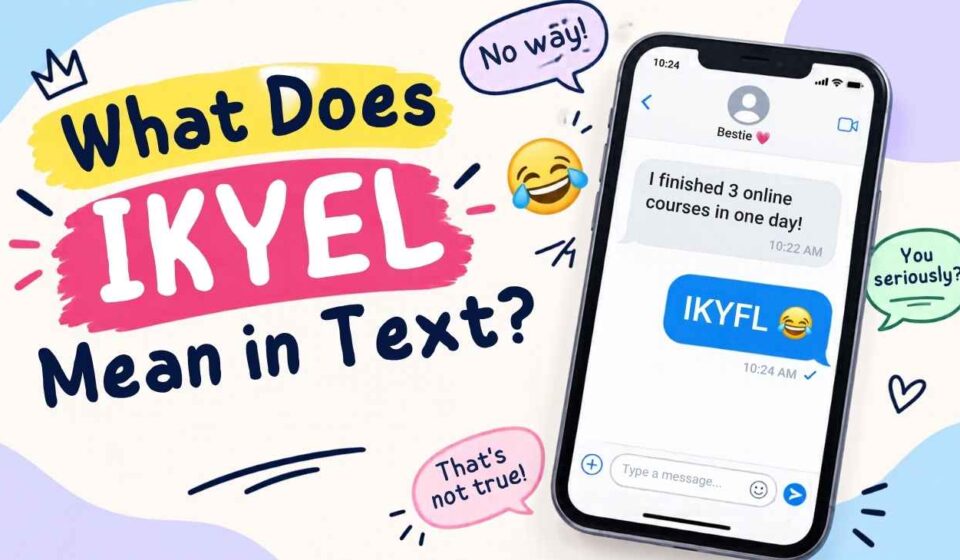

Have you ever received a message containing IKYFL and wondered what the other person was trying to say? This abbreviation often appears in text messages, social media comments, and group chats when someone hears something surprising or difficult to believe. If you have never seen it before, its meaning might not be immediately obvious.
IKYFL usually stands for “I Know You F*ing Lying.”** People use it to express disbelief, shock, or playful suspicion when someone shares an unbelievable story. Depending on the conversation, it can sound funny, sarcastic, or slightly confrontational. Let’s explore what IKYFL means, how people use it, and how to respond when it appears in your messages.
What Does IKYFL Mean?
IKYFL stands for “I Know You F*ing Lying.”** It is an informal internet abbreviation used when someone thinks another person is exaggerating, joking, or telling a story that sounds completely unbelievable.
For example, imagine your friend tells you they bought a brand-new car without spending any money. You might reply, “IKYFL 😂” to show that you find their claim hard to believe.
The expression does not always mean that the sender genuinely believes someone is lying. Friends often use it to react dramatically to surprising news or funny stories. However, it can sound rude when used during a serious disagreement.
In some conversations, people may interpret IKYFL differently, but the lying-related meaning is the most widely recognized. Always consider the surrounding messages before deciding what the sender intends.
Simple Meaning (In Plain Words)
In simple words, IKYFL means “I don’t believe what you’re saying!” It is a stronger, more dramatic way to express surprise or question someone’s claim.
Think about a friend who usually struggles to wake up early. One morning, they text you, “I woke up at 4 a.m. and finished all my homework before breakfast.” You might respond, “IKYFL! Since when do you wake up that early?”
Your message communicates surprise and playful disbelief. You are not necessarily accusing your friend of telling a serious lie; you are reacting to something unexpected.
Depending on your tone and relationship, IKYFL can mean anything from “No way!” to “You’re seriously expecting me to believe that?” The context determines whether it feels humorous or insulting.
Also read: Backshots Meaning, Uses, Contexts and Safety Explained
Where Is IKYFL Used?
IKYFL appears in casual digital conversations, particularly on platforms where people communicate through short messages and quick reactions.
Here are some common places where you might encounter it:
- Snapchat: Friends may use IKYFL when reacting to surprising snaps or unbelievable stories.
- Instagram: It can appear in comments, reels discussions, and direct messages.
- TikTok: Users may write IKYFL under videos featuring unexpected situations or bold claims.
- WhatsApp: People often use it in private conversations and group chats to tease friends.
- Facebook: It may appear in comments when someone shares a surprising experience.
- Discord: Gamers and online communities might use it when reacting to unexpected announcements or exaggerated claims.
Although people can use IKYFL across different platforms, it is not suitable for every situation. It belongs mainly in informal conversations rather than professional emails, official messages, or serious discussions.
Why Do People Use IKYFL?
People use IKYFL because it communicates a strong reaction without requiring a complete sentence. It also adds personality to conversations.
1. To express disbelief: When a friend’s story sounds impossible, IKYFL quickly communicates that you are not convinced.
2. To show surprise: Sometimes people share unexpected news that leaves everyone speechless. The abbreviation makes that reaction clear.
3. To tease friends: Close friends often exaggerate their stories for fun. IKYFL can turn the moment into a playful exchange.
4. To add humor: Adding a laughing emoji can make the message feel less serious and more entertaining.
5. To save time: Instead of typing a longer response, people can use five letters to communicate their reaction.
However, IKYFL is not automatically friendly just because it is slang. The relationship between the people and the subject of the conversation can change how the message feels.
Real-Life Examples of IKYFL
The easiest way to understand IKYFL is to see how it works in everyday conversations. Here are some fresh examples.
Example 1: An unbelievable achievement
Friend: “I finished three online courses in one afternoon.”
You: “IKYFL 😭 How did you manage that?”
Here, you are surprised by your friend’s productivity and want to know whether the claim is true.
Example 2: A shopping surprise
Friend: “I found a designer jacket for just five dollars.”
You: “IKYFL 😂 Show me where you bought it!”
This response expresses disbelief while keeping the conversation lighthearted.
Example 3: A surprising school story
Classmate: “The teacher canceled every assignment for the entire month.”
You: “IKYFL, are you serious?”
You find the news difficult to believe and want confirmation.
Example 4: A relationship conversation
Friend: “He said he forgot my birthday, but he remembered everyone else’s.”
You: “IKYFL. That sounds suspicious.”
In this situation, the abbreviation expresses skepticism rather than simple amusement.
Example 5: A gaming conversation
Friend: “I won five matches in a row without losing once.”
You: “IKYFL, you’re actually unstoppable today!”
Here, the expression combines surprise with friendly teasing.
These examples show that IKYFL can communicate humor, doubt, and amazement. The surrounding conversation helps establish its intended tone.
IKYFL vs Similar Terms
IKYFL belongs to a larger group of internet expressions that communicate disbelief, frustration, or surprise. However, these abbreviations are not interchangeable in every situation.
| Term | Meaning | How It Is Used |
|---|---|---|
| IKYFL | I Know You F***ing Lying | Strong disbelief or playful suspicion |
| FR | For Real | Asking for confirmation or expressing agreement |
| SMH | Shaking My Head | Showing disappointment or disbelief |
| BFFR | Be F***ing for Real | Telling someone to be serious |
| WYF | What You F***ing | Meaning depends on context; not a direct equivalent |
| IYKYK | If You Know, You Know | Referring to an inside joke or shared experience |
For example, you might use “FR?” when you simply want confirmation. IKYFL is more dramatic and suggests that a statement sounds unbelievable.
Similarly, BFFR can challenge someone’s behavior or opinion, while IKYFL specifically reacts to something the sender believes may be untrue.
When Should You Use IKYFL?
IKYFL works best when you are talking with people who understand your humor and are comfortable with informal language.
Consider using it when a close friend tells an unbelievable story, someone makes an exaggerated claim, or a group chat is already full of jokes. It can make your reaction more expressive without requiring a lengthy reply.
However, avoid using IKYFL in professional conversations, formal messages, or sensitive discussions. The abbreviation contains profanity, so it may offend people who dislike strong language.
It is also worth avoiding when someone is sharing a personal problem or serious concern. Responding with IKYFL could make them feel that you are dismissing their feelings.
When you are unsure, a simple “Really?” or “Are you serious?” is a safer alternative.
Common Misunderstandings About IKYFL
Although the abbreviation is relatively straightforward, people can misunderstand it in several ways.
First, IKYFL does not always indicate a serious accusation. Friends may use it jokingly without believing that anyone has actually lied.
Second, it does not always communicate anger. The sender might be shocked, amused, or surprised rather than upset.
Third, it is not appropriate for every audience. Because it includes profanity, some people may interpret it as disrespectful even when the sender intends to joke.
Finally, context matters. A message containing IKYFL after a funny story may feel playful, while the same message during an argument could sound aggressive.
If you cannot tell what someone means, consider asking them directly instead of assuming their intention.
Pro Tips for Using IKYFL Correctly
Want to use IKYFL naturally without making your messages awkward? Keep these tips in mind.
- Understand the conversation: Use it when the other person’s message genuinely invites a surprised or skeptical reaction.
- Know your audience: Save it for friends who are comfortable with casual slang and profanity.
- Use emojis thoughtfully: A laughing emoji may signal humor, but it cannot guarantee that the message will be received positively.
- Avoid serious situations: Choose a more considerate response when someone is discussing an important personal issue.
- Do not overuse it: Using the same expression in every conversation can make your replies feel repetitive.
- Check the context: If a message seems ambiguous, ask what the sender means before responding.
The goal is to make your communication clearer, not to create unnecessary confusion or conflict.
Final Thoughts
IKYFL usually means “I Know You F*ing Lying.”** It is a popular style of internet slang used to express disbelief, surprise, skepticism, or playful teasing in informal conversations.
You might see it in Snapchat messages, Instagram comments, TikTok discussions, or everyday group chats. Its tone can range from funny and friendly to blunt and confrontational, depending on the situation.
Now that you understand its meaning, you can recognize IKYFL more easily and decide whether it fits your own conversations. When in doubt, remember that the relationship, subject, and tone matter just as much as the abbreviation itself.
FAQ
1. What does IKYFL mean in text messages?
IKYFL usually means “I Know You F***ing Lying.” People use it when something sounds unbelievable or when they want to express strong disbelief.
2. Is IKYFL rude?
It can be. The expression contains profanity and may sound confrontational in serious conversations. Among close friends, however, it is often used jokingly.
3. What does IKYFL mean on Snapchat?
On Snapchat, IKYFL generally has the same meaning as in other messaging apps. Someone might send it in response to a surprising snap, an unbelievable story, or a playful exaggeration.
4. How should I reply when someone says IKYFL?
Your response depends on the situation. You could say “I’m serious 😂,” “Believe it or not,” or “I swear it’s true!” If the person seems genuinely upset, explain yourself calmly.
5. Is IKYFL the same as IYKYK?
No. IKYFL usually expresses disbelief that someone is telling the truth. IYKYK means “If You Know, You Know” and refers to information or experiences understood by people familiar with a particular situation.
6. Can I use IKYFL in professional messages?
It is best to avoid it in professional communication. The profanity and informal tone may be inappropriate for workplace emails, client messages, and official discussions.
7. Does IKYFL always mean someone is lying?
No. Although its usual meaning refers to someone supposedly lying, it can be used humorously to react to exaggerations or surprising claims without making a serious accusation.