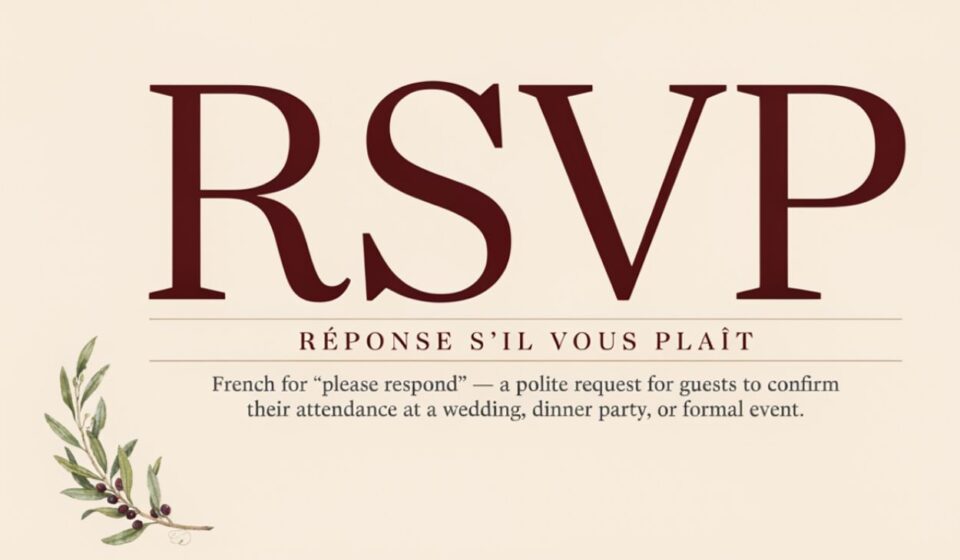

RSVP comes from the French phrase “Répondez s’il vous plaît,” which means “please respond.” You’ll usually see it on invitations when the host wants guests to confirm whether they plan to attend. An RSVP can be as simple as saying yes or no, although some invitations also ask about meal choices, guests, or other details.
Today, RSVP appears on everything from wedding cards and birthday invitations to work events, online meetings, and social-media event pages. The basic idea remains the same: the organizer needs your answer so they can plan properly.
What Does RSVP Mean?
RSVP is an abbreviation taken from French. The phrase “Répondez s’il vous plaît” literally asks the invited person to respond. In everyday English, the easiest way to understand RSVP is “please reply” or “please let us know if you’re coming.”
When an invitation says “RSVP by Friday,” the host isn’t simply adding decorative wording. They’re asking you to make a decision before a specific date. Your response tells them how many people will attend and helps them prepare accordingly.
For example, imagine you’re invited to a birthday dinner with “RSVP by June 10” printed at the bottom. You should tell the host whether you’ll attend by that date rather than leaving them uncertain.
Why Is It Written in French?
RSVP stayed in use because French was historically associated with formal communication, culture, and social etiquette. Using a French expression on invitations became a convention, particularly for formal occasions.
Interestingly, the expression isn’t necessarily the everyday wording someone in France would choose today. In English-speaking countries, however, RSVP became so familiar that many people use it without even thinking about its French origin.
So, although the letters look like a simple English abbreviation, their roots are distinctly French.
Also read: What Does WYT Mean in Text? Complete Guide
Full Definition
RSVP can describe both the act of replying to an invitation and the reply itself. Its meaning becomes clearer when you look at how people use the word in sentences.
As a Verb
RSVP can function as a verb when you’re talking about responding to an invitation.
For example:
- “Have you RSVP’d for the wedding?”
- “Please RSVP before Monday.”
- “I already RSVP’d that I’m attending.”
In casual writing, you’ll often see forms such as RSVP’d or RSVP’d yes. The word has become common enough in English that people comfortably use it as an action.
As a Noun
RSVP can also refer to the response a guest sends.
For example:
- “We’ve received 40 RSVPs.”
- “Your RSVP was received this morning.”
- “I need to send my RSVP tonight.”
In this use, the RSVP isn’t the invitation itself. It’s the guest’s answer to the invitation.
The Redundancy Issue
You may have noticed invitations saying “Please RSVP.” Technically, the wording repeats the idea of “please” because the French phrase already contains “s’il vous plaît,” meaning “please.”
However, this expression is extremely common in modern English. Most people don’t consider it a serious mistake, and hosts regularly use “Please RSVP” because it sounds natural and immediately understandable.
If you want something cleaner, you can write “RSVP by July 5” or simply “Kindly respond by July 5.”
Context and Usage
RSVP can appear in many situations, and the level of formality depends heavily on the event.
Formal Events
Weddings, formal dinners, conferences, charity functions, and corporate gatherings often require a definite RSVP. Organizers may need exact numbers for catering, seating, name badges, transportation, or venue arrangements.
If the invitation gives you an RSVP date, it’s best to respond before that deadline. A late response can make planning more difficult.
Casual Events
RSVP isn’t limited to formal occasions. Friends may use it when organizing birthdays, barbecues, game nights, house parties, or weekend gatherings.
The response can be informal. A message such as “Yes, I’ll be there!” may be all the host needs.
Digital Events
Online events use RSVP systems too. Webinars, virtual workshops, networking sessions, and online parties may ask people to register in advance.
Your RSVP may allow the organizer to send you a meeting link, reminder, schedule, or other event information.
Real-Life Examples
Seeing RSVP in normal conversations makes its meaning much easier to understand.
1: Wedding Invitation
Host: “The wedding invitations are out. Could you RSVP by May 10?”
Guest: “Absolutely. I’ll check the details and respond before then.”
Here, the host needs a final attendance number for wedding arrangements.
2: Casual Party
Friend: “We’re having a barbecue Saturday. Can you come?”
Guest: “I think so. I’ll confirm tomorrow.”
In this situation, a formal RSVP card isn’t necessary. A simple confirmation serves the same purpose.
3: Work Event
Manager: “Please RSVP using the company event link.”
Employee: “Sure. Should I include my spouse in the response?”
The RSVP helps the organizers know how many people will attend.
4: Digital Event
Organizer: “RSVP for Thursday’s online workshop and we’ll send you the access details.”
Participant: “Done. I’ve registered.”
Here, the RSVP is connected to online registration.
5: Last-Minute Invite
Friend: “Are you free for dinner tonight?”
Guest: “Yes, I can make it.”
Even without the word RSVP, the guest has essentially provided the confirmation the host needs.
Platform-Specific Meaning
The basic meaning of RSVP stays the same online, but the way you respond can change from platform to platform.
On WhatsApp, RSVP may appear through event features or simply as a message in a group or private chat. Someone might ask, “Please RSVP for Saturday.”
You can usually answer directly with yes, no, or maybe, depending on what the organizer allows.
Snapchat
Snapchat invitations tend to be informal. A friend might send you a snap about a party and ask whether you’re coming.
There may not be a formal RSVP button, but replying to the message still gives the host the confirmation they’re looking for.
TikTok
On TikTok, RSVP can appear in posts promoting events, meetups, live activities, or online gatherings. A creator might direct viewers to an external registration page.
In this setting, RSVP generally means registering or confirming that you intend to participate.
Facebook Events
Facebook Events commonly provide attendance choices such as Going, Interested, or Can’t Go.
If you need to clearly confirm attendance, selecting “Going” communicates a stronger commitment than simply marking yourself as interested.
Eventbrite and Meetup
Event platforms such as Eventbrite and Meetup use RSVP or registration features to organize attendance.
Depending on the event, you may need to provide additional information such as your name, contact details, dietary requirements, or guest information.
Email Invitations
Email RSVPs are straightforward. The sender may provide a button or link, or they may ask you to reply directly.
A short response such as “Yes, I’ll attend. Thank you for the invitation.” is usually enough unless additional information is requested.
Alternative Meanings and Variations
RSVP has several closely related expressions. These alternatives can make an invitation sound more formal, casual, or specific.
RSVP, Regrets Only
RSVP, regrets only changes the normal response expectation. It generally means you only need to contact the host if you cannot attend.
If you’re able to attend, no response may be necessary under that instruction.
Regrets Only
“Regrets only” is a shorter version of the same idea. It’s sometimes used when the organizer expects most invited guests to attend.
Always follow the exact instruction printed on the invitation rather than assuming every RSVP request works the same way.
Please Reply
“Please reply” is the simplest English alternative to RSVP. It removes any uncertainty for guests who may not recognize the French abbreviation.
Kindly Respond
“Kindly respond” has a more polished and formal feel. You may see it on wedding invitations, professional events, or other occasions where the host wants a courteous tone.
Confirm Your Attendance
This wording is very direct. It tells guests exactly what information the organizer wants.
It’s especially useful for conferences, meetings, workshops, and professional gatherings.
Let Me Know
“Let me know” feels relaxed and personal. Friends and family commonly use it for informal plans.
For example, “Let me know if you can make it Saturday” communicates essentially the same practical request as an RSVP.
Related Terms and NLP Variations
Several words and phrases are closely connected with RSVP:
| Term | Meaning |
|---|---|
| Répondez s’il vous plaît | French phrase behind RSVP |
| SVP | French abbreviation meaning “please” |
| Headcount | Total number of people attending |
| Save the date | Early notice about an upcoming event |
| Plus-one | An additional guest permitted by the invitation |
| Regrets only | Respond only if you cannot attend |
| Confirm attendance | Clearly state whether you will attend |
| Reply by [date] | Specifies the response deadline |
Understanding these terms can make invitations much easier to interpret.
How to Respond to an RSVP
Responding properly doesn’t have to be complicated. The important thing is to provide the information the host requested.
1: Read the Invitation Carefully
Check the entire invitation before responding. Look for the deadline, response method, guest rules, meal choices, dress requirements, and any other instructions.
Don’t assume every invitation follows the same process.
2: Respond by the Deadline
If the invitation says “RSVP by August 1,” try to answer before August 1.
Hosts often need your response before they finalize catering, seating, venue arrangements, or other details.
3: Be Clear About Your Answer
Give a definite response whenever possible.
Say “Yes, I’ll attend” or “Unfortunately, I won’t be able to attend.” Avoid leaving the host guessing about your plans.
4: Include Additional Information if Requested
Some invitations ask for information beyond attendance.
You might need to mention your meal preference, the name of your guest, accessibility needs, or other requested details. Providing everything together saves unnecessary back-and-forth.
5: Follow Through on Your Commitment
If you say yes, try to attend as promised. If your circumstances change, tell the host as soon as you reasonably can.
This gives the organizer a chance to update their plans.
Misinterpretations and Common Mistakes
RSVP is simple, but people still misunderstand what they’re expected to do.
1: Thinking RSVP Means “Reply Only If You Are Coming”
A standard RSVP asks for a response whether you’re attending or not.
If you cannot come, saying so is still useful because the host can update the expected guest count.
2: Assuming the Host Will Chase You
Don’t rely on the host to remind you personally. If an invitation provides a deadline, responding is normally the guest’s responsibility.
3: Bringing Uninvited Guests
An RSVP for one person doesn’t automatically give you permission to bring someone else.
If the invitation doesn’t mention a plus-one, ask the host before adding another guest.
4: RSVPing “Maybe” When a Clear Answer Is Needed
“Maybe” can be difficult for event planning. Unless the organizer offers that option, try to give a definite answer.
If you genuinely don’t know yet, explain the situation and tell the host when you expect to know.
5: Forgetting to RSVP Altogether
Ignoring an RSVP request creates unnecessary uncertainty. Even if you casually mentioned your plans before, complete the requested RSVP when possible.
When NOT to Use RSVP
RSVP is useful, but not every gathering needs formal attendance confirmation.
Open House Events
Open houses often allow guests to arrive and leave whenever convenient. Since there may not be a fixed guest count, a formal RSVP may not be necessary.
Public Events
Large public events such as festivals or concerts generally don’t require individual RSVP responses unless the organizer specifically requests registration.
Very Small Gatherings
For dinner with a few close friends, a quick text may be more natural than a formal RSVP system.
When the Invitation Does Not Request It
If an invitation doesn’t ask you to RSVP, don’t automatically assume that a formal response is required.
Still, if the event involves food, seating, or special arrangements, letting the host know your plans can be considerate.
Usage Tips for Hosts
If you’re organizing an event, a well-designed RSVP process can make planning much easier.
Set a Clear Deadline
Give guests a specific date instead of saying “respond soon.”
A clear deadline makes it easier for everyone to understand when their answer is needed.
Provide Multiple Response Options
Depending on your audience, you might offer a website, email address, phone number, or reply card.
The easier it is to respond, the less friction guests face.
Send Reminders
Some people simply forget. A friendly reminder can help you collect missing responses without making guests feel pressured.
Follow Up with Non-Responders
Once the deadline passes, contact guests who haven’t answered if their attendance matters to your planning.
Keep the message polite and straightforward.
Be Gracious About Declines
A guest saying no doesn’t necessarily reflect anything negative about your event. People may have work, travel, family obligations, or other commitments.
Thank them for responding and move forward with the updated headcount.
The Importance of RSVP in Event Planning
An RSVP gives organizers information they can use to make practical decisions.
Food and Beverage Planning
Catering depends heavily on the number of people attending. Knowing the expected guest count helps organizers estimate meals, drinks, desserts, and other refreshments.
Seating Arrangements
Formal events often require planned seating. Confirmed responses make it easier to prepare tables, chairs, place cards, and seating assignments.
Budget Management
Each additional guest can affect event costs. Accurate attendance information helps organizers estimate expenses more realistically.
Logistics and Planning
Transportation, parking, printed materials, gifts, name badges, and other details can depend on attendance.
A reliable RSVP list gives organizers a clearer picture of what they’ll need.
Guest Experience
Good attendance information also helps hosts prepare for individual needs. For example, they may arrange suitable meals, name tags, welcome materials, or seating preferences.
RSVP Etiquette Summary
RSVP etiquette is mainly about being clear, timely, and considerate.
For Guests
- Respond before the stated deadline.
- Give a clear yes or no whenever possible.
- Provide requested information.
- Respect the invitation’s guest limits.
- Inform the host if your plans change.
For Hosts
- Give guests a specific response deadline.
- Make the RSVP process easy.
- Send polite reminders when needed.
- Contact people who haven’t responded after the deadline.
- Respect guests who cannot attend.
Frequently Asked Questions
What does RSVP stand for?
RSVP comes from the French phrase “Répondez s’il vous plaît,” meaning “please respond.”
Does RSVP mean yes or no?
No. RSVP means that the guest should respond. The response can be either acceptance or a decline.
Is “Please RSVP” grammatically wrong?
It’s technically repetitive because the original French phrase already includes “please,” but “Please RSVP” is widely used in English.
Can RSVP be used as a verb?
Yes. You can say, “I need to RSVP,” meaning that you need to respond to an invitation.
What does “RSVP by Friday” mean?
It means the host wants your response no later than Friday.
What does “regrets only” mean?
It generally means you only need to respond if you cannot attend.
Can I RSVP for someone else?
Only when the invitation or organizer allows it. Otherwise, it’s better for each invited person to provide their own response.
What should I do if I miss the RSVP deadline?
Contact the host as soon as possible, explain that you missed the deadline, and ask whether they can still accommodate you.
Does RSVP always require a formal response?
No. For casual events, a text or direct message may serve as the RSVP.
Is RSVP still used online?
Yes. Online event platforms, social networks, email invitations, and virtual events commonly use RSVP systems.
Conclusion
RSVP is a small phrase with an important job: it tells an event host that they need your response. Although the term comes from French, it has become a normal part of English invitations and everyday event planning.
Whether you’re replying to a wedding invitation, confirming a friend’s party, registering for an online workshop, or responding to a work event, the basic rule is simple: read the instructions, answer clearly, and respond on time.
Understanding RSVP also helps you avoid common invitation mistakes. When you’re the guest, your response helps the host prepare. When you’re the host, a clear RSVP process gives you the information needed to organize the event smoothly.