
If you’ve ever received a message that simply says “TD”, you may have wondered what it means. Like many internet abbreviations, TD can have several different meanings, and the correct one depends on the conversation. That’s why it can sometimes be confusing, especially if you’re new to texting slang.
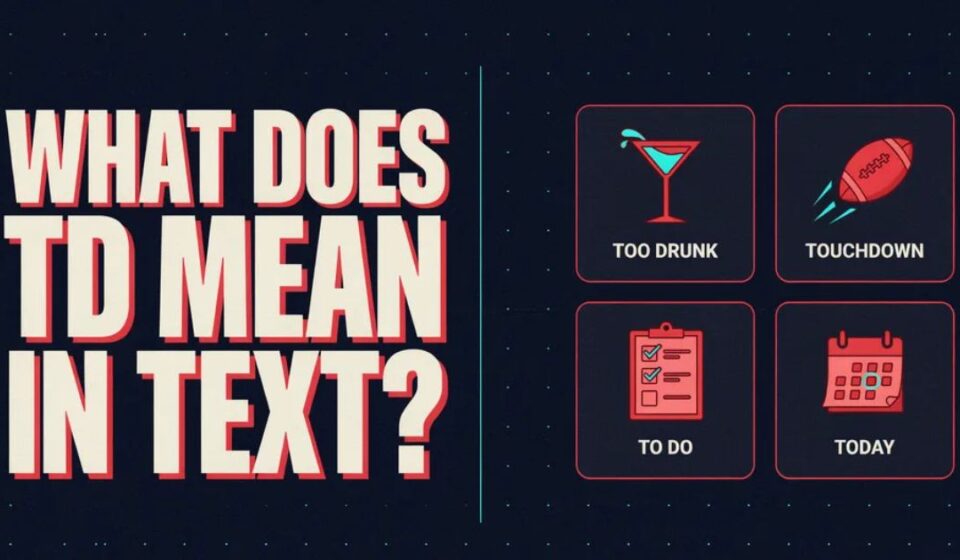
In most chats, TD stands for Too Drunk, Touchdown, To Do, or Today. Each meaning is used in a different situation, so understanding the context is the key to figuring out what the sender means.
In this guide, you’ll learn every common meaning of TD, when people use it, and how to recognize the right definition in a conversation.
What Does TD Mean in Text?
TD is a popular abbreviation used in text messages, social media posts, online chats, and even productivity apps. Unlike many internet slang terms that have only one definition, TD has multiple meanings.
The four most common meanings are:
- Too Drunk
- Touchdown
- To Do
- Today
For example:
- “I’m td after the party.” = Too Drunk
- “What a td!” = Touchdown
- “I’ll add it to my td list.” = To Do
- “Are you free td?” = Today
The topic of the conversation usually makes the intended meaning clear.
TD Meaning: Too Drunk
One of the most common meanings of TD in casual texting is “Too Drunk.” Friends often use it after parties or social events to explain that they’ve had too much to drink.
This abbreviation is usually meant in a lighthearted or humorous way. It helps people send quick messages without typing a full sentence.
Example:
- “Sorry, I’m td right now. I’ll text you tomorrow.”
- “He was td after the concert.”
When it’s used:
- After parties
- During nights out
- Group chats with friends
- Funny conversations
- Casual social media posts
Tone:
- Informal
- Playful
- Relaxed
- Humorous
This meaning should only be used with people you’re comfortable chatting with.
TD Meaning: Touchdown
In American football, TD is the standard abbreviation for Touchdown. Fans, sports commentators, and players frequently use it while discussing games.
A touchdown is one of the biggest scoring plays in football, so you’ll often see “TD” in live chats, sports news, and social media during matches.
Example:
- “That was an amazing TD!”
- “Our team scored another TD in the final quarter.”
Also read: What Does BBG Mean in Text? 🤔 Learn When & How to Use It (2026)
When it’s used:
- Football games
- Sports forums
- Live game discussions
- Sports news
- Fan conversations
Tone:
- Excited
- Energetic
- Sports-focused
- Celebratory
If the conversation is about football, TD almost always means Touchdown.
TD Meaning: To Do
Another popular meaning of TD is “To Do.” People use it as a shortcut when talking about tasks, reminders, and daily responsibilities.
Instead of writing “to-do list,” many simply write “TD list” in messages or notes.
Example:
- “I’ll put it on my TD list.”
- “Finish everything on your TD before Friday.”
When it’s used:
- Work chats
- Study planning
- Personal reminders
- Productivity apps
- Daily scheduling
Tone:
- Practical
- Organized
- Neutral
- Efficient
This version of TD is common among students and professionals who like typing quickly.
TD Meaning: Today
Sometimes TD simply means “Today.” It’s a quick way to shorten messages when discussing schedules or making plans.
Although not everyone uses it, you’ll occasionally see TD in fast-paced conversations.
Example:
- “Can we meet td?”
- “The package should arrive td.”
When it’s used:
- Scheduling plans
- Daily conversations
- Quick text messages
- Family chats
- Friend groups
Tone:
- Casual
- Neutral
- Convenient
- Time-saving
If someone is talking about dates or appointments, TD often refers to Today.
Where Is TD Commonly Used?
Because TD has several meanings, you’ll find it across many online platforms.
Popular platforms:
- Facebook Messenger
- Instagram DMs
- Snapchat
- SMS text messages
- Discord
- Gaming chats
- Productivity apps
- Sports discussion forums
People use abbreviations like TD to make conversations faster and easier.
Tone & Style:
TD is mainly used in:
- Casual conversations
- Friendly chats
- Sports discussions
- Task management
- Informal online communication
It is generally not suitable for formal writing, business emails, or academic work.
Examples of TD in Conversation
Here are some simple conversations that show how TD can have different meanings depending on the context.
Too Drunk
Emma: Are you still coming to the after-party?
Jake: I don’t think so. I’m td already! 😂
Chris: Why did you stop replying last night?
Noah: Sorry, I was td and fell asleep.
Touchdown
Ben: Did you watch the football game?
Lucas: Yes! That final TD won the match.
Mia: Our team is playing great today.
Ava: I know! That TD was incredible. 🏈
To Do
Olivia: Have you finished your homework?
Sophia: Not yet. It’s still on my TD list.
Ryan: Don’t forget to send the email.
Daniel: Thanks! I’ll add it to my TD list.
Today
Anna: Are we meeting tomorrow?
Lily: No, we’re meeting td at 3 PM.
Ethan: Is the project deadline next week?
Mason: Nope, it’s due td, so let’s finish it now.
When to Use and When Not to Use TD
Knowing when to use TD helps avoid misunderstandings.
When to Use TD
- Chatting with friends
- Casual text messages
- Social media conversations
- Sports discussions
- Personal reminders
- Informal planning
When Not to Use TD
Avoid using TD in:
- Business emails
- School assignments
- Professional reports
- Official documents
- Job applications
- Client communication
In formal situations, it’s better to write the full words instead of abbreviations.
Similar Slang Words or Alternatives
If you’re learning texting abbreviations, here are a few other common ones:
| Abbreviation | Meaning |
|---|---|
| BRB | Be Right Back |
| TMR | Tomorrow |
| IDK | I Don’t Know |
| BTW | By The Way |
| FYI | For Your Information |
| WYD | What Are You Doing? |
| LOL | Laugh Out Loud |
| TBH | To Be Honest |
| ASAP | As Soon As Possible |
| IMO | In My Opinion |
Learning these abbreviations can make online conversations much easier to understand.
Why TD Has Multiple Meanings
Many internet abbreviations have more than one definition, and TD is a perfect example. Since it’s made up of only two letters, different communities have adopted it for different purposes.
Sports fans naturally use TD for Touchdown, while people organizing tasks use it for To Do. Friends chatting after a party may use it for Too Drunk, and others use it as a quick way to say Today.
The surrounding words usually reveal the intended meaning. If someone mentions football, TD almost certainly means Touchdown. If they’re discussing plans, it likely means Today. Reading the entire message instead of focusing only on the abbreviation makes it much easier to understand.
FAQ’s About What Does TD Mean in Text
What does TD stand for in texting?
In texting, TD most commonly stands for Too Drunk, Touchdown, To Do, or Today, depending on the context.
Is TD always the same meaning?
No. TD has multiple meanings, so you need to look at the rest of the conversation to understand which one is being used.
Is TD used in formal communication?
Generally, no. TD is considered an informal abbreviation and is best suited for casual conversations.
What does TD mean in sports?
In sports, especially American football, TD stands for Touchdown, which is one of the primary ways a team scores points.
What does TD mean in chat?
In chat, TD can mean Too Drunk, Today, or To Do. The correct meaning depends on what people are discussing.
How do I know which TD meaning is correct?
Read the surrounding words and consider the topic of the conversation. Context is the easiest way to identify the correct meaning of TD.
Final Thoughts
TD is a short abbreviation with several different meanings, making it a versatile part of modern texting. Whether it refers to Too Drunk, Touchdown, To Do, or Today, the surrounding conversation almost always tells you which definition fits best.
As texting continues to evolve, abbreviations like TD help people communicate more quickly while keeping conversations simple and natural. The next time you see “TD” in a message, you’ll know exactly how to interpret it by paying attention to the context.