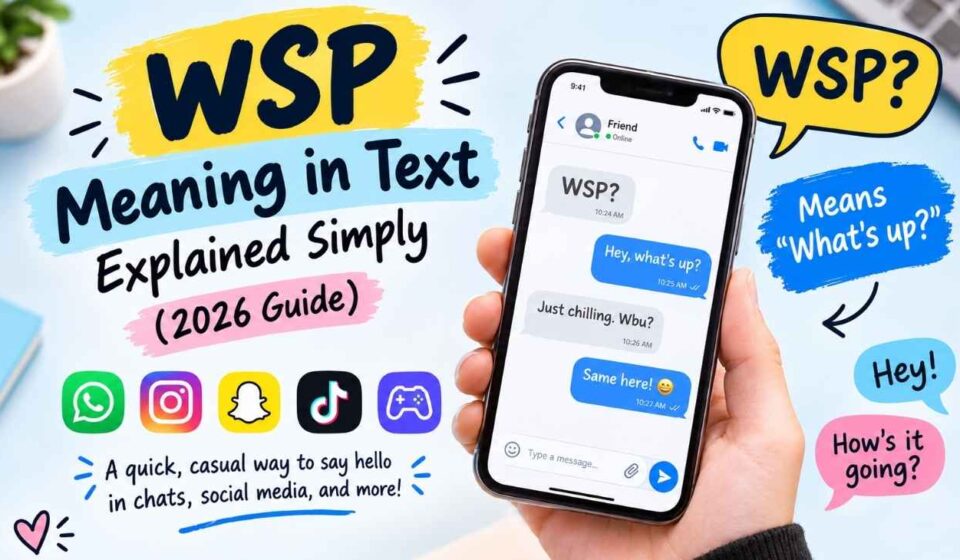

Imagine checking your phone after a busy day and finding a message that simply says, “WSP?” You might wonder whether it is a question, a greeting, or some new internet slang you have never heard before.
There is no need to overthink it. WSP is a popular abbreviation used in casual text conversations, social media messages, and online chats. Once you understand its meaning, you can recognize it easily and respond without feeling confused.
In this guide, you will learn what WSP means in text, where people use it, how it differs from similar abbreviations, and how to reply naturally in different situations.
What Does “WSP Mean in Text”?
WSP stands for “What’s up?” It is an informal expression people use to greet someone, ask how things are going, or start a conversation. Instead of typing the complete phrase, they shorten it to three letters to save time.
For example, someone might send you “WSP” when they want to talk but do not have a particular question in mind. It can be similar to saying “Hey,” “How’s it going?” or “What are you doing?” depending on the context.
The exact meaning can vary slightly between conversations. Sometimes the sender wants to know how you are feeling, while other times they are simply opening the door to a chat.
Featured Snippet Definition:
WSP means “What’s up?” in text messages. It is a casual abbreviation used to greet someone, ask what is happening, or start a conversation with friends and other people in informal settings.
Simple Meaning of WSP (In Easy Words)
The easiest way to understand WSP is to think of it as a quick way to say hello and check in with someone. It is commonly used between friends, classmates, gaming partners, and people who regularly chat online.
Imagine meeting a friend outside a shop and asking, “Hey, what’s up?” Sending WSP in a message serves a similar purpose. It makes the conversation feel relaxed without requiring a long introduction.
However, WSP does not always mean that the sender wants a detailed update about your life. Often, it is just a friendly opener that gives you a chance to continue the conversation.
Also read: SYBAU Meaning Slang | What It Really Stands For
Example in simple form:
- “WSP, you free later?” = What’s up? Are you available later?
- “Yo WSP” = Hey, how’s it going?
- “WSP with the new project?” = What’s happening with the new project?
The surrounding words help you understand whether the person is greeting you or asking about a specific situation.
Where Is WSP Used?
WSP appears in many forms of digital communication, especially when people want to send short messages. You may see it in private conversations, group chats, gaming communities, or comments where informal language is common.
It is not limited to one age group or platform. Its use depends more on someone’s texting habits and the people they communicate with.
Common Platforms:
- WhatsApp: Friends may use WSP to begin a conversation or check whether someone is available.
- Instagram: It can appear in direct messages when someone wants to connect with a follower or friend.
- Snapchat: Users may send WSP as a quick opener before sharing snaps or chatting.
- TikTok: People might use it in private messages or informal conversations.
- Gaming chats: Players can use WSP to ask teammates what is happening or whether they are ready to play.
Example:
Suppose someone you follow on Instagram sends, “WSP, how’s your week going?” They are probably trying to start a friendly conversation rather than asking you to explain a particular problem.
On WhatsApp, a friend might send “WSP, got a minute?” This suggests they want to talk and may have something to discuss.
Why Do People Use WSP?
Online conversations often move quickly, so people look for simple ways to communicate. Abbreviations such as WSP help them send a message without typing every word.
Another reason is familiarity. When friends regularly use internet slang, short expressions can feel more natural than complete sentences. WSP can make an ordinary greeting sound relaxed and conversational.
Main Reasons:
- Faster typing: Three letters are quicker to send than the full phrase.
- Casual communication: It keeps everyday conversations informal.
- Conversation starters: It gives the other person an easy opportunity to reply.
- Social familiarity: Friends may use it because it matches their usual texting style.
- Convenience: It works well when someone wants to check in without writing a long message.
Still, using WSP is a personal choice. You do not need to use slang just because other people do. A simple “Hey, how are you?” works just as well.
Real-Life Examples of WSP in Text
The meaning of WSP becomes easier to understand when you see how it fits into different conversations. Here are five fresh examples showing how people might use it in everyday situations.
Example 1: Friendly greeting
Maya: “WSP! Haven’t seen you online lately.”
Noah: “Been busy with college stuff. How about you?”
Here, Maya uses WSP to greet Noah and reconnect after some time apart.
Example 2: Starting chat
Ari: “WSP, did you check out that new café?”
Sam: “Not yet. Is it any good?”
In this conversation, WSP opens the discussion, and the rest of the message gives the other person something specific to answer.
Example 3: Gaming chat
Player 1: “WSP squad, who’s joining the next match?”
Player 2: “I’m in. Give me five minutes.”
The abbreviation creates a casual group greeting before the players organize their next game.
Example 4: Casual check-in
Lena: “WSP? You seemed quiet in class today.”
Riya: “Just tired, nothing serious.”
Here, Lena uses WSP to check in with someone. The additional sentence makes it clear that she has noticed a change in Riya’s mood.
Example 5: Chill vibe
Jordan: “WSP 😎 enjoying the weekend?”
Chris: “Absolutely, just watching movies.”
The emoji and relaxed wording give this message a friendly tone. Jordan is simply inviting Chris to chat.
WSP vs Similar Terms
WSP is not the only abbreviation people use to greet others. Several expressions have similar meanings, but each can create a slightly different impression.
| Term | Meaning | Common use |
|---|---|---|
| WSP | What’s up? | Casual greetings and check-ins |
| WYD | What are you doing? | Asking about someone’s current activity |
| SUP | What’s up? | Informal greeting |
| HBU | How about you? | Returning a question or asking for an update |
| WYA | Where you at? | Asking someone’s location |
| HEY | Hello | General greeting |
These expressions are not always interchangeable. For example, WSP can simply start a conversation, while WYD more directly asks what someone is doing.
Key Insight:
WSP is mainly a greeting or conversation starter, while WYD asks about an activity and WYA asks about a location. Understanding the surrounding message helps you choose the right interpretation.
When Should You Use WSP?
WSP is appropriate when you are chatting with someone in a relaxed setting. It is particularly useful when you want to say hello without making your opening message feel too formal.
Your relationship with the recipient matters, too. An abbreviation that feels natural between close friends might seem unfamiliar to someone who rarely uses internet slang.
Good situations:
- Messaging friends or classmates.
- Starting a casual conversation on social media.
- Checking in with someone you know.
- Greeting teammates in an online game.
- Reconnecting with someone you have not spoken to recently.
For example, sending “WSP, are we still meeting this evening?” to a friend sounds casual and direct.
Avoid using it:
WSP is generally unsuitable for formal communication. In professional situations, clear and complete wording usually creates a better impression.
Avoid using it in job applications, business emails, academic assignments, or messages to clients who expect professional language.
Instead of writing “WSP” to a manager, you could say, “Hello, I hope you’re doing well. I wanted to ask about the meeting schedule.”
Common Misunderstandings About WSP
Although WSP is simple, people sometimes interpret it incorrectly. Understanding these common mistakes can help you avoid confusion when chatting online.
1. Thinking WSP is something serious
WSP is usually a casual expression rather than a warning or serious announcement. If someone sends it without additional information, they are most likely greeting you or trying to begin a conversation.
Of course, the rest of the message matters. If someone follows WSP with a serious question, respond to the complete message rather than focusing only on the abbreviation.
2. Confusing it with other meanings
In everyday texting, WSP commonly means “What’s up?” However, abbreviations can have specialized meanings in particular workplaces, technical communities, or niche online groups.
If the conversation is about a specific subject and the usual meaning does not fit, consider the context before deciding what the sender intended.
3. Using it in formal situations
Some people become comfortable with texting abbreviations and begin using them everywhere. However, WSP may look unprofessional in a formal email or an important work message.
When in doubt, write the complete greeting. It is clear, polite, and easy for everyone to understand.
4. Misreading tone
A message containing only “WSP” can sometimes seem blunt because it has no extra explanation or punctuation. That does not automatically mean the sender is annoyed or unfriendly.
Some people naturally send short messages. Consider your usual communication style with that person and the broader conversation before assuming a negative tone.
Pro Tips for Using WSP
Knowing the definition is only the first step. How you use WSP can affect whether your message feels friendly, natural, or out of place.
1. Use emojis for friendliness
An emoji can make a short greeting feel warmer when it suits your usual texting style. For example, “WSP 🙂 how have things been?” sounds like a friendly check-in.
You do not need to add an emoji to every message, though. A simple greeting is often enough.
2. Don’t overuse it
Sending WSP repeatedly without adding anything to the conversation can make your messages feel repetitive. Try including a question or mentioning something you want to discuss.
For example, “WSP, did you finish that book you were talking about?” gives the other person a clear topic to respond to.
3. Use it to start conversations
WSP works best when you want to open a casual conversation. If you have a particular question, you can include it in the same message instead of waiting for the other person to reply.
This makes communication easier and helps prevent unnecessary back-and-forth messages.
4. Match the vibe
Pay attention to how the other person usually communicates. If they enjoy casual slang, WSP may fit naturally. If they prefer complete sentences or professional language, use a more conventional greeting.
The goal is not to sound trendy. It is to communicate comfortably and clearly.
Final Thoughts
WSP means “What’s up?” in text messages. It is a casual abbreviation used to greet people, check in with friends, and start conversations on platforms such as WhatsApp, Instagram, Snapchat, and gaming chats.
Its meaning is usually straightforward, but the surrounding words can help you understand whether someone is simply saying hello or asking about a particular situation.
The next time you receive a WSP message, you can reply naturally with “Not much, how about you?”, share what you are doing, or ask the sender what’s going on.
Remember, WSP belongs mainly in informal conversations. Use it when it feels appropriate, keep your replies natural, and choose clearer wording whenever the situation calls for a more professional tone.