
Seeing NWS in a text can be confusing if you’re not familiar with the abbreviation. In most casual texting, NWS means “No Worries,” a relaxed way to say “it’s okay,” “no problem,” or “don’t stress.” However, NWS can mean something different in certain online contexts, so the surrounding conversation matters. This guide explains the NWS meaning in text, where it comes from, how people use it, and how to respond naturally.
NWS Meaning in Text + Definition
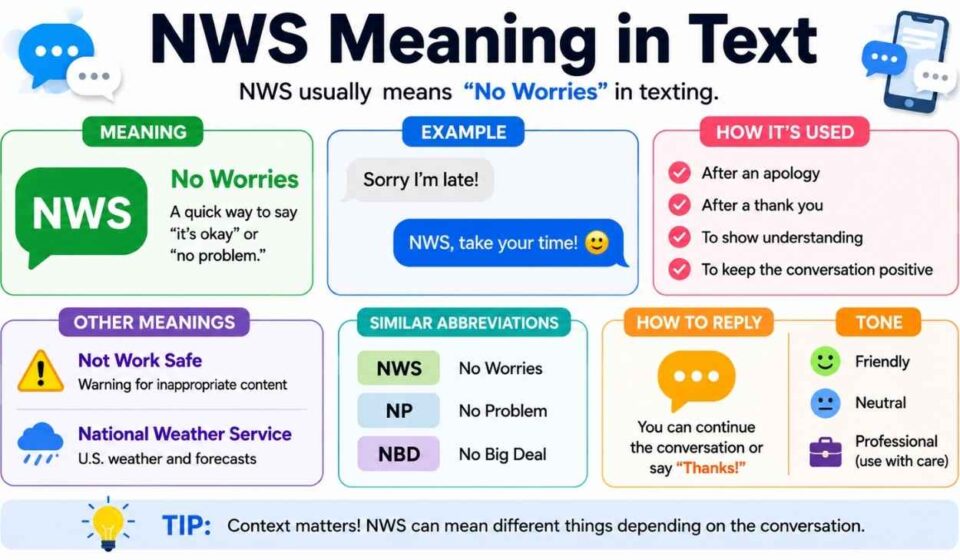
In texting and internet slang, NWS usually means “No Worries.” It is an informal abbreviation used to reassure someone that there isn’t a problem.
For example, if someone apologizes for replying late, you might respond:
“NWS, I was busy too.”
Here, NWS simply means “No worries.”
It can communicate several similar ideas, including:
- No problem
- It’s okay
- Don’t worry about it
- All good
- No stress
- That’s fine
The expression is generally friendly and relaxed. It is most appropriate in texts, DMs, group chats, and other informal conversations rather than formal writing.
The lowercase form “nws” is also common in casual messaging. Wiktionary specifically lists nws as an internet-slang and text-messaging initialism for “no worries.”
Also read: Backshots Meaning, Uses, Contexts and Safety Explained
Quick Definition Table
| Term | Meaning | Context | Tone |
|---|---|---|---|
| NWS | No Worries | Texting and casual chats | Friendly, relaxed |
| NWS | Not Work Safe | Online content warnings | Cautionary |
| NWS | National Weather Service | Weather-related discussions | Formal/informational |
| NP | No Problem | Texting and messaging | Casual, reassuring |
| NBD | No Big Deal | Texting and social media | Casual, dismissive/reassuring |
When someone sends “NWS” as a standalone reply after an apology or thank-you, “No Worries” is usually the intended meaning.
What Does NWS Mean in a Text Message?
NWS means “No Worries” in a casual text message. People use it when they want to tell someone that an apology, mistake, delay, favor, or minor inconvenience isn’t a big deal.
For instance:
Person A: Sorry I forgot to call you.
Person B: NWS!
The second person isn’t upset. They’re saying, “No worries.”
NWS can also be used after someone says thank you:
Person A: Thanks for sending that over.
Person B: NWS.
In this situation, NWS is similar to “no problem” or “you’re welcome.”
Context is important because NWS has other meanings online. If it appears next to a link, image, or video, it may instead be a warning meaning “Not Work Safe.” That usage is related to content-warning language such as NSFW.
Example
Person A: Sorry, I couldn’t make it yesterday.
Person B: NWS, we’ll catch up this weekend.
Meaning: Person B is saying that there is no problem and they aren’t upset.
Another example:
Person A: Thanks for waiting!
Person B: NWS 😊
Here, NWS means “No worries” and gives the conversation a friendly, reassuring tone.
The Origin of NWS
There isn’t one universally documented person, website, or event that can be credited with creating NWS meaning “No Worries.” The abbreviation follows a broader texting habit of shortening common phrases to their initial letters.
The phrase “no worries” itself is much older than modern texting and is especially familiar in Australian and other varieties of English. As digital communication became faster, people naturally began shortening frequently used expressions.
Historical online evidence shows that NWS meaning “no worries” was being used in internet and instant-message slang by at least the early 2010s. Urban Dictionary has an entry dated March 13, 2013, defining NWS as “no worries” for quick text and instant-message replies.
NWS also developed a separate meaning, “Not Work Safe,” as an online content warning. That meaning is distinct from the reassuring “No Worries” usage.
Because slang develops organically, it’s better to view NWS as part of the wider evolution of internet shorthand rather than assign it a single official origin date.
How NWS Is Used Today
Today, NWS is mainly encountered in casual digital communication. The meaning depends heavily on what comes before and after the abbreviation.
1. Text Messaging
In ordinary text messages, NWS is commonly used as a short reply to an apology or thank-you.
Example:
“Sorry for being late.”
“NWS, take your time.”
The sender is reassuring the other person that everything is fine.
2. Social Media Messages
NWS can appear in DMs and casual social-media conversations.
For example:
“Sorry I didn’t see your message earlier.”
“NWS!”
It keeps the exchange brief without sounding overly formal.
3. Group Chats
In a group chat, NWS can quickly reassure someone after a small mistake or misunderstanding.
Example:
“My bad, I sent the wrong file.”
“NWS, just send the right one.”
It can make the conversation feel more relaxed.
4. Workplace Chats
NWS can occasionally appear in workplace messaging when coworkers already have a casual communication style.
For example:
“Sorry, I’ll have the numbers ready in an hour.”
“NWS, no rush.”
However, even in workplace chats, you should consider the company culture and the relationship between the people involved. A formal email is usually better written in complete words.
Examples of NWS in Text Conversations
The easiest way to understand NWS is to see how it works naturally in different conversations.
Friendly Examples
Person A: Sorry I missed your call.
Person B: NWS, call me whenever you’re free.
Here, NWS means “No worries” and shows that the missed call wasn’t a problem.
Person A: Thanks for grabbing my coffee!
Person B: NWS 😊
In this example, NWS works like “No problem.”
Casual Examples
Person A: I might be 10 minutes late.
Person B: NWS.
Person A: Sorry, I forgot to send the screenshot.
Person B: NWS, send it when you can.
The abbreviation keeps the conversation short and easygoing.
Professional Examples
NWS can sometimes be used between coworkers who regularly communicate casually:
Coworker A: Sorry for the delay on that report.
Coworker B: NWS. Just send it when it’s ready.
Even though this is understandable, a more professional alternative would be:
“No worries. Please send it when it’s ready.”
For formal clients, managers, business emails, or important workplace communication, writing the full phrase is usually the safer choice.
Tone of NWS in Texting
The tone of NWS depends on the conversation. Most of the time, it is reassuring and informal.
Friendly Tone
When used between friends, NWS can sound warm and supportive.
“Sorry I couldn’t come tonight.”
“NWS, we’ll hang out another day.”
Adding an emoji or friendly follow-up can make the reassurance even clearer.
Neutral Tone
A simple “NWS” can also be completely neutral.
“Thanks for letting me know.”
“NWS.”
It communicates that the situation isn’t a problem without adding much emotion.
Professional Tone
NWS is not inherently rude, but the abbreviation is informal. In professional situations, “No worries” or “No problem” is generally clearer than the three-letter abbreviation.
For example:
Informal:
“NWS, I’ll handle it.”
More professional:
“No worries. I’ll handle it.”
The second version feels more polished while keeping the same meaning.
NWS Examples by Context
Context can make it much easier to understand what NWS means.
Texting a Friend
Friend: Sorry, I totally forgot.
You: NWS 😂
Meaning: “No worries, it’s fine.”
Family Conversation
Sibling: Can you pick me up later?
You: NWS, just text me when you’re ready.
Here, NWS means there isn’t a problem with the request.
Dating Conversation
Person A: Sorry, I didn’t reply earlier. I had a busy day.
Person B: NWS, hope everything’s okay.
In a dating conversation, NWS can help make a response sound relaxed rather than annoyed.
However, tone still matters. A short “NWS.” with no additional context could sometimes feel distant, depending on the relationship and previous messages.
Workplace Chat
Coworker: Sorry, I need another 20 minutes to finish this.
Coworker: NWS, take your time.
In a casual internal chat, this can work. For a formal business exchange, spelling out the phrase would be more appropriate.
Group Chat
Person A: Sorry guys, I accidentally deleted the message.
Person B: NWS, just send it again.
The abbreviation works well because group chats generally favor quick, informal communication.
Why People Use NWS
There are several reasons someone might choose NWS instead of typing the complete phrase.
Saves Time
Typing three letters is faster than typing “no worries.” In fast conversations, small abbreviations can keep messages moving.
Sounds Relaxed
NWS has a casual feel. It can make a response sound less serious than a formal sentence.
For example:
“NWS, you’re good.”
feels much more relaxed than:
“There is no need for you to be concerned about the situation.”
Shows Understanding
NWS can reassure another person that you understand their situation and aren’t holding a small mistake against them.
If someone says:
“Sorry I forgot.”
and you answer:
“NWS.”
you’re essentially saying, “I understand. It’s okay.”
Keeps Conversations Positive
A quick “NWS” can prevent a minor problem from becoming a bigger conversation.
Instead of focusing on an apology or mistake, the response moves the conversation forward.
NWS vs Similar Texting Abbreviations
NWS is similar to several other abbreviations, but they aren’t completely interchangeable.
NWS vs NP
NWS means “No Worries.”
NP usually means “No Problem.”
Both can reassure someone, but they can have slightly different conversational feels.
Example:
“Sorry I made you wait.”
“NWS.”
or:
“Sorry I made you wait.”
“NP.”
Both responses indicate that the sender isn’t bothered.
NWS may sound a little more conversational, while NP is an especially common short form of “no problem.”
NWS vs NBD
NBD means “No Big Deal.”
It’s used when someone wants to emphasize that something isn’t important or serious.
Example:
“Sorry I spilled some water.”
“NBD.”
NWS and NBD overlap, but they aren’t identical. NWS focuses more on reassurance, while NBD emphasizes that the situation isn’t significant.
| Abbreviation | Full Meaning | Main Idea |
|---|---|---|
| NWS | No Worries | Everything is okay |
| NP | No Problem | There isn’t an issue |
| NBD | No Big Deal | It isn’t important |
Alternative Ways to Say NWS
If you don’t want to use an abbreviation, there are plenty of natural alternatives.
Casual Alternatives
You can replace NWS with:
- No worries
- No problem
- All good
- You’re good
- It’s fine
- Don’t worry about it
- No stress
- It’s all good
- Not a problem
For example:
“Sorry I forgot!”
Instead of “NWS,” you could say:
“All good!”
or:
“No worries!”
Professional Alternatives
In professional communication, clearer alternatives include:
- No problem.
- No worries.
- That’s completely fine.
- That’s okay.
- No need to worry.
- Not an issue.
- That’s understandable.
For a formal email, you could write:
“No problem. Please send the updated document when it’s ready.”
This communicates the same basic idea without relying on slang.
Does NWS Have Other Meanings?
Yes. NWS doesn’t always mean “No Worries.”
One important alternative is “Not Work Safe,” which can be used as a warning that content may be inappropriate or unsuitable to view in a workplace or other public setting. This meaning is related to the much more familiar abbreviation NSFW (“Not Safe for Work”).
For example:
“NWS — don’t open this at work.”
In that situation, the sender isn’t saying “no worries.” They’re warning you about the content.
NWS can also refer to the National Weather Service in weather-related discussions. Wiktionary lists NWS as the U.S. National Weather Service as well as other non-slang meanings.
The best way to determine the intended meaning is to examine the context:
- Reply to “sorry” or “thanks” → likely “No Worries”
- Before a questionable link or image → possibly “Not Work Safe”
- Weather forecast or warning → likely “National Weather Service”
Don’t automatically assume that every instance of NWS means the same thing.
Common Mistakes When Using NWS
Using It in Formal Emails
NWS is informal slang. Using it in a business proposal, formal email, academic assignment, or official document can make your writing sound too casual.
Instead of:
“NWS, I’ll send it tomorrow.”
Use:
“No problem. I’ll send it tomorrow.”
Assuming Everyone Knows It
Not everyone recognizes internet abbreviations. If you’re communicating with someone who doesn’t regularly use texting slang, “No worries” is clearer than NWS.
This is especially important when the conversation is important or there could be confusion.
Using It in a Serious Situation
NWS works best for minor problems, apologies, delays, and everyday inconveniences.
If someone is discussing something genuinely serious, responding with a quick “NWS” could sound dismissive or insensitive.
For example, if someone is dealing with a major personal problem, a more thoughtful response is appropriate. The goal isn’t simply to use the shortest possible phrase; it’s to match the tone of the conversation.
FAQ About NWS Meaning in Text
What does NWS mean in texting?
NWS usually means “No Worries” in casual texting. It’s a quick way to say “no problem,” “it’s okay,” or “don’t worry about it.” It’s commonly used after someone apologizes, thanks you, or mentions a minor inconvenience.
Is NWS a slang word?
Yes. When NWS means “No Worries,” it’s an informal internet and texting abbreviation rather than standard formal English. It’s most suitable for casual messages, DMs, group chats, and conversations with friends or people who are comfortable with texting slang.
Is NWS rude?
Usually, no. NWS generally has a friendly or reassuring meaning. However, tone depends on context. A very short “NWS.” could feel cold or dismissive in some conversations, especially if the other person is discussing something serious.
Can NWS mean something besides No Worries?
Yes. NWS can also mean “Not Work Safe” as an online content warning, and it can refer to the National Weather Service in weather-related contexts. The surrounding conversation usually makes the intended meaning clear.
What is the difference between NWS and NP?
NWS means “No Worries,” while NP means “No Problem.” Both can be used to reassure someone after an apology or thank-you. They’re often interchangeable in casual texting, although NWS can feel slightly more conversational.
Can I use NWS at work?
You can use NWS in a casual workplace chat if your team regularly uses abbreviations and informal language. However, it’s better to avoid it in formal emails, client communication, official documents, or situations where clarity and professionalism matter.
How should I reply when someone says NWS?
Usually, you don’t need a special response. You can simply continue the conversation. If someone says NWS after you apologize, you could say “Thanks,” “I appreciate it,” or just move on to the next part of the conversation.
Conclusion
The most common NWS meaning in text is “No Worries.” It’s a short, casual way to reassure someone that everything is fine, particularly after an apology, thank-you, delay, or small mistake.
NWS is useful in friendly texts, DMs, group chats, and other informal conversations. Just remember that the abbreviation can have other meanings, including “Not Work Safe” and “National Weather Service,” so context matters.
If you’re ever unsure, look at what surrounds the abbreviation. A reply to “sorry” or “thanks” probably means No Worries. A warning attached to a link or image may mean something completely different.
When clarity matters, especially in professional communication, simply writing “No worries” is usually the better choice.