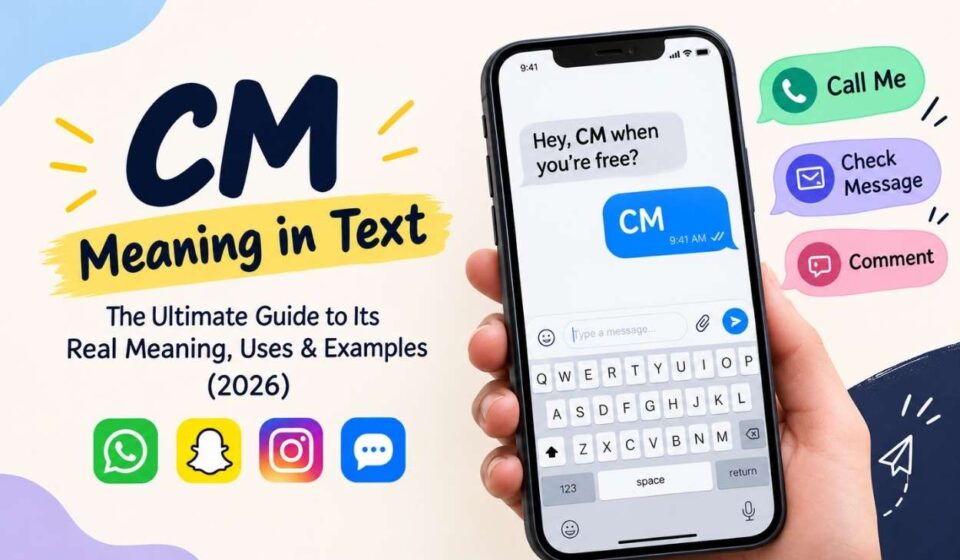

Have you ever received a text that simply says “CM” and wondered what the person actually meant? You’re not alone. Short abbreviations are everywhere in texting, Snapchat, Instagram, and other social platforms, and their meanings can change depending on the conversation.
The most common CM meaning in text is “Call Me.” However, that isn’t the only possible interpretation. In some situations, CM can mean “Check Message” or something else entirely.
Let’s look at what CM means, how people use it, and how to understand the intended meaning from context.
What Does CM Mean?
In texting, CM most commonly means “Call Me.” Someone may send it when they want you to phone them rather than continue chatting through messages.
For example:
- “CM when you’re free.”
- “Hey, CM ASAP.”
- “I need to tell you something. CM.”
- “CM after work.”
The meaning can range from casual to urgent. If a friend texts “CM when you get a chance,” they probably just want to talk. If someone writes “CM ASAP,” they likely want a call sooner.
In some conversations, CM can also stand for “Check Message.” This usually happens when someone has already sent information elsewhere and wants you to look at it. The surrounding words are the best clue to the intended meaning.
Also read: What Does WDYW Mean in Text? Meaning, Examples & How to Use It (2026)
Origin and Background of the Term
“CM” belongs to the larger world of internet and texting abbreviations. These shortened expressions became popular as digital communication became faster and more frequent.
Instead of typing an entire sentence, people began using a few letters to communicate an idea quickly. Abbreviations such as “BRB,” “LOL,” “OMG,” and “IDK” became familiar parts of online conversations. CM follows the same basic idea. Typing two letters can be much quicker than writing “Call me when you have time.”
There isn’t one universally documented moment when CM became popular. Rather, it developed naturally alongside texting culture, where convenience and speed became important.
How CM Is Used in Daily Life
CM is usually used in informal conversations where both people understand texting shorthand.
You might see it in:
- Text messages between friends
- Family group chats
- Snapchat conversations
- Instagram messages
- Gaming chats
- Casual online conversations
For example, a friend might text, “CM tonight, I have some news.” A family member could say, “CM when you reach home.” The abbreviation is particularly useful when the sender wants to move the conversation from texting to a phone call.
However, the meaning isn’t always about making a phone call. If someone says, “CM, I sent you the address,” they could be asking you to check a message rather than call them.
Emotional or Practical Meaning of CM
The meaning behind CM can depend heavily on the sender’s tone and situation. When CM means “Call Me,” it can communicate several different intentions.
A casual “CM later” may simply mean the person wants to catch up. A message such as “CM, please” might suggest that they want your attention.
In more serious situations, CM can indicate urgency. For example, if someone normally sends detailed messages but suddenly writes “CM ASAP,” you may reasonably assume that something needs immediate attention.
The relationship between the people also matters. Between close friends, CM may feel completely normal. From someone you barely know, it may sound unusually direct.
Similar or Related Terms
Several other abbreviations and phrases are commonly used when someone wants to communicate privately or continue a conversation.
Call me: The complete phrase and the clearest alternative to CM.
Text me: Usually means the person wants you to send them a message.
DM me: Means “direct message me,” especially on social media.
PM me: Short for “private message me” and commonly used online.
HMU: Usually means “hit me up,” which is a casual invitation to contact someone.
These expressions overlap in purpose, but they aren’t interchangeable in every situation.
Is CM Always “Call Me”?
No. Although “Call Me” is one of the most common meanings, you shouldn’t automatically assume that every CM means the same thing.
Context is important.
For instance:
| CM Meaning | Example |
|---|---|
| Call Me | “CM when you’re free.” |
| Check Message | “CM, I sent the information.” |
| Comment | “CM your thoughts below.” |
The last meaning is less universal, so it should only be assumed when the surrounding conversation clearly supports it. If you’re unsure, simply ask the sender what they mean. A quick clarification is better than misunderstanding an important message.
CM Meaning on Snapchat
On Snapchat, CM can commonly mean “Call Me.” Friends may use it when they want to switch from snaps or chat messages to a phone conversation.
For example:
- “CM when you get home.”
- “CM later, I have something to tell you.”
- “Can’t type right now, CM.”
- “CM when you’re free.”
Snapchat conversations are often fast and informal, so abbreviations fit naturally into the platform’s communication style. Still, Snapchat doesn’t give CM one fixed meaning. The conversation surrounding the abbreviation should always be considered.
When Should You Avoid Using CM?
CM is best saved for casual communication. Avoid relying on it when you’re writing something professional or formal, especially if the recipient may not understand texting abbreviations.
It’s better to write the full phrase in:
- Business emails
- Job applications
- School assignments
- Client messages
- Formal workplace communication
- Official requests
Instead of writing “CM ASAP,” a professional message might say, “Please call me as soon as you are available.” Clarity is more important than saving a few seconds of typing.
Common Misunderstandings About CM
One of the biggest mistakes people make with abbreviations is assuming they always have one fixed meaning.
Here are some common misunderstandings:
“CM always means Call Me.”
Not necessarily. Context can change the intended meaning.
“CM always means something urgent.”
No. Someone may use it simply because they prefer talking on the phone.
“CM is appropriate everywhere.”
It is generally informal and may not be suitable for professional communication.
“Everyone understands CM.”
Not everyone uses the same internet slang. When clarity matters, spell it out.
“The abbreviation tells you the sender’s tone.”
Not completely. Tone depends on the rest of the message, punctuation, relationship, and situation.
Examples of CM in Sentences
Here are some natural examples of CM meaning “Call Me”:
- “CM when you finish your class.”
- “I have something important to tell you. CM.”
- “CM later tonight if you’re free.”
- “CM when you get home.”
- “Can you CM after dinner?”
- “I’m driving right now, CM in an hour.”
- “CM ASAP—I need your advice.”
- “Don’t text everything here. CM me.”
- “CM whenever you have a minute.”
- “Busy at the moment. CM later?”
If CM means “Check Message,” the context could look different:
- “CM, I sent the details in our group chat.”
- “CM before you leave.”
- “CM—I just sent you the photos.”
Why Understanding CM Meaning in Text Matters Today
Digital communication is built around speed, but speed can sometimes create confusion. Understanding abbreviations helps you interpret messages without jumping to the wrong conclusion. Knowing what CM means can also help you understand the tone of a conversation. A short “CM” may be casual, while “CM ASAP” can suggest urgency.
At the same time, recognizing that abbreviations can have multiple meanings is just as important. Instead of relying on the letters alone, look at the words around them and consider who sent the message. Good digital communication isn’t only about typing quickly. It’s about making sure the other person understands what you mean.
Conclusion
The most common CM meaning in text is “Call Me.” It is a simple abbreviation used when someone wants another person to make a phone call. However, CM doesn’t have one universal definition. Depending on the conversation, it may refer to “Check Message” or another phrase. This is why context matters whenever you encounter unfamiliar texting slang.
For casual conversations with friends and family, CM can be a convenient shortcut. For professional or formal communication, writing the complete phrase is usually the safer choice. When in doubt, look at the surrounding message—or simply ask what the sender means.
FAQ’s
What does CM mean in texting?
CM most commonly means “Call Me.” It is usually used when someone wants you to phone them.
What does CM mean on Snapchat?
On Snapchat, CM can mean “Call Me.” Its exact meaning depends on the context of the conversation.
Can CM mean something besides Call Me?
Yes. Depending on the context, CM can sometimes mean “Check Message” or another phrase.
Is CM formal or informal?
CM is generally informal texting language. It is better to avoid it in professional emails, academic writing, and official communication.
What should I reply when someone texts CM?
If you understand it as “Call Me,” you can reply with something like “Sure, I’ll call you soon” or simply call when you’re available.
Does CM mean Call Me urgently?
Not always. The urgency depends on the rest of the message. “CM ASAP” sounds urgent, while “CM later” is usually casual.
Is CM commonly used in texting?
Yes. CM can be used as a quick way to ask someone to call, particularly in casual digital conversations.